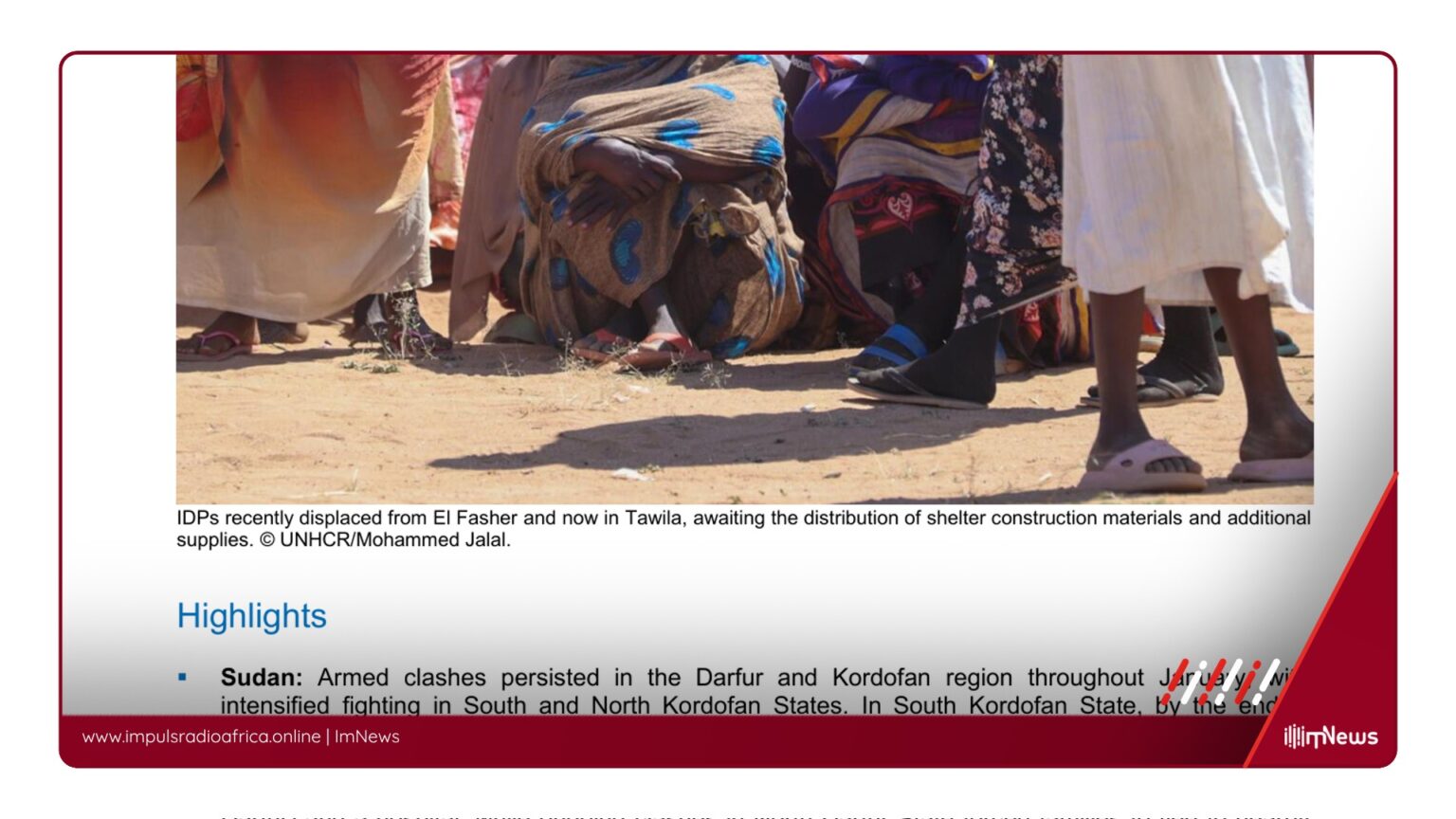
Armed clashes have continued to grip the Darfur and Kordofan regions of Sudan throughout January 2026, with particularly intense fighting reported in South and North Kordofan States. By the end of the month, the siege on Dilling in South Kordofan State was lifted, and efforts to end the siege on Kadugli intensified. The situation in Kadugli was later reported to have been resolved in early February.
In the meantime, drone attacks in North, West, and South Darfur States have led to new displacement and caused significant damage to infrastructure, including Nyala Airport in South Darfur and a local hospital. Ongoing clashes in North Darfur State have forced families to seek refuge in nearby villages or cross into Chad.
In the neighboring Central African Republic (CAR), the security situation in Vakaga prefecture, which borders Sudan, remains fragile and volatile. Despite a period of relative calm in Birao and Vakanga, reports of robbery, extortion, and looting along key transit routes, such as the Ouanda-Djallé, Sikikédé–Mangagne, and Tissi–Sarayevo roads, highlight the continued vulnerability of civilians to armed actors. Incidents of intercommunal violence have also been recorded, indicating a persistently concerning security and protection environment.
High Commissioner Barham Salih conducted his first mission to Chad between 13 and 16 January 2026, combining high-level meetings in N’Djamena with field visits to Abéché, Adré, Farchana, and Iriba in Eastern Chad. The mission emphasized Chad’s exemplary solidarity in hosting refugees fleeing the Sudan crisis and highlighted the urgent need to scale up life-saving assistance and invest in resilience. In Farchana, the High Commissioner met with refugee leaders and newly arrived families from El Fasher, visited the Digital Learning Centre, and community farms.
In Adré, he visited the border crossing and registration centre, engaging with new arrivals and families with specific needs. In Abéché, he held discussions with the Governor of Ouaddaï and met with refugee professionals, including teachers, medical staff, and lawyers. The mission concluded in N’Djamena with a joint UNCT/HCT meeting, engagements with UNHCR staff, and a high-level dinner with donors.
Parallel senior missions from the United States Embassy and the World Food Programme further underscored the growing international attention to the evolving humanitarian situation along the Sudan border.
In Egypt, a delegation from the European Civil Protection and Humanitarian Aid Operations (ECHO) visited UNHCR’s protection and assistance interventions on 11 January 2026. The visit focused on UNHCR’s response in key areas such as cash assistance, prevention and response to violence against women and girls (VAWG), and legal protection. The delegation visited UNHCR’s registration centre and partner organizations delivering frontline services, highlighting UNHCR’s efforts to prioritize and streamline interventions amidst ongoing funding constraints.
In Ethiopia, a high — level United States Government (USG) delegation visited Ura Refugee Site on 21 January 2026 to review operational priorities and funding gaps. The mission reaffirmed strong USG engagement and underscored urgent needs in food security, health referrals, water, sanitation and hygiene (WASH), education, and shelter.
In Libya, UNHCR published the results of a phone survey conducted between October and November 2025 by national partner Moomken, in cooperation with UNHCR. The survey of 2,503 Sudanese refugee households, representing approximately 10,750 individuals, revealed that only 4 per cent plan to return to Sudan within the next six months, while the majority (80 per cent) wish to move onward, with North America (notably Canada) and Europe as primary destinations. Security concerns in Sudan are the dominant constraint for return, alongside the lack of basic services and fears about safety along return routes. Among those considering return, most view it as a medium- to long-term possibility.
In Uganda, the security situation in Kiryandongo Settlement, which hosts the largest population of Sudanese refugees, has continued to deteriorate, driven by economic hardship and underlying ethnic tensions.
In South Sudan, Aweil in Northern Bahr El Ghazal state has seen a substantial influx of new arrivals over the past 30 days, with 2,470 individuals recorded, one of the highest monthly figures to date. This surge is attributed to escalating insecurity and worsening humanitarian conditions in border areas of Sudan, prompting more people to flee southward. In January, UNHCR continued to register rising numbers of new refugee arrivals from Sudan, with a total of 1,816 refugees arriving in Wedweil Refugee Settlement, including 1,591 self-relocated refugees and 225 individuals relocated from Abyei with UNHCR facilitation. Funding constraints are limiting UNHCR’s ability to conduct protection monitoring in Western Bahr El Ghazal, Warrap, and the Abyei Administrative Area, where 17,659 refugees are currently registered.
Source: reliefweb