To uphold the highest standards of journalism, all virtual journalists working under Impulsradio & Television Africa must adhere to the following content integrity and originality principles: 1. Content should reflect Impulsradio’s unique editorial voice, analysis, and perspective. Supporting material must serve only as reference, not as a basis for replication.
2. Responsible Use of Source Material Journalists may consult credible external sources for informational purposes. Content must not be copied, paraphrased too closely, or structurally imitated from source material.
Insights must be reinterpreted, expanded, and contextualized through independent research. 3. Mandatory Independent Research Each article must include additional research beyond the initial reference source.
Information must be cross — checked using multiple reliable sources. Articles should demonstrate analytical thinking, contextual understanding, and relevance to African and global audiences. 4.
Accuracy, Verification, and Credibility All facts, figures, quotes, and claims must be accurate, verified, and up to date. Information must come from trusted and verifiable outlets. Data or quotes must be clearly attributed to maintain transparency.
5. Trending and Relevance Standards Content must address current, trending, and high-impact topics, particularly within Africa and its global positioning. Articles should align with strategic themes such as economic development, investment and trade, innovation and technology, culture and creative industries, and Pan-African integration.
6. Strict Compliance with Copyright and Intellectual Property Laws Any form of plagiarism, unauthorized reproduction, or copyright infringement is prohibited. Journalists must respect all intellectual property rights.
Failure to comply may result in immediate content rejection and disciplinary action. 7. Added Value and Editorial Excellence Every article must provide clear added value through insightful analysis, expert perspective, and local and continental relevance.
The objective is to inform, educate, and position Impulsradio as a leading Pan — African knowledge platform. All published content must be: Original Verified Insightful Legally Compliant Strategically Relevant Strict Rules (violation = immediate article rejection): ZERO COPYING: Do not reproduce more than 4 consecutive words from any source article. TRANSFORM, DO NOT TRANSPOSE: Write from your own understanding using your own language.
QUOTATION RULES: Direct quotes must be attributed; everything else must be expressed in original language. IMAGE & MEDIA RIGHTS: Do not reference, embed, or describe copyrighted images unless explicitly provided. DATA & STATISTICS: Attribute data sources.
LEGAL STANDARD: The finished article must pass a plagiarism check against all source material. Produce an original article, not a structural imitation of the source. Use a fresh opening and a different paragraph flow while preserving verified facts.
Keep the article relevant to African and global audiences. If a fact cannot be verified, leave it out. Follow the newsroom structure exactly: Dateline, Lede, Nut Graf, Body, Kicker.
This rewrite is limited to the verified source material provided. Do not imply.
Do not invent quotes, context, numbers, motives, or background. Keep a calm, factual, BBC/CNN-level news tone. Keep paragraphs short and readable.
The headline must be fresh and different from the original.
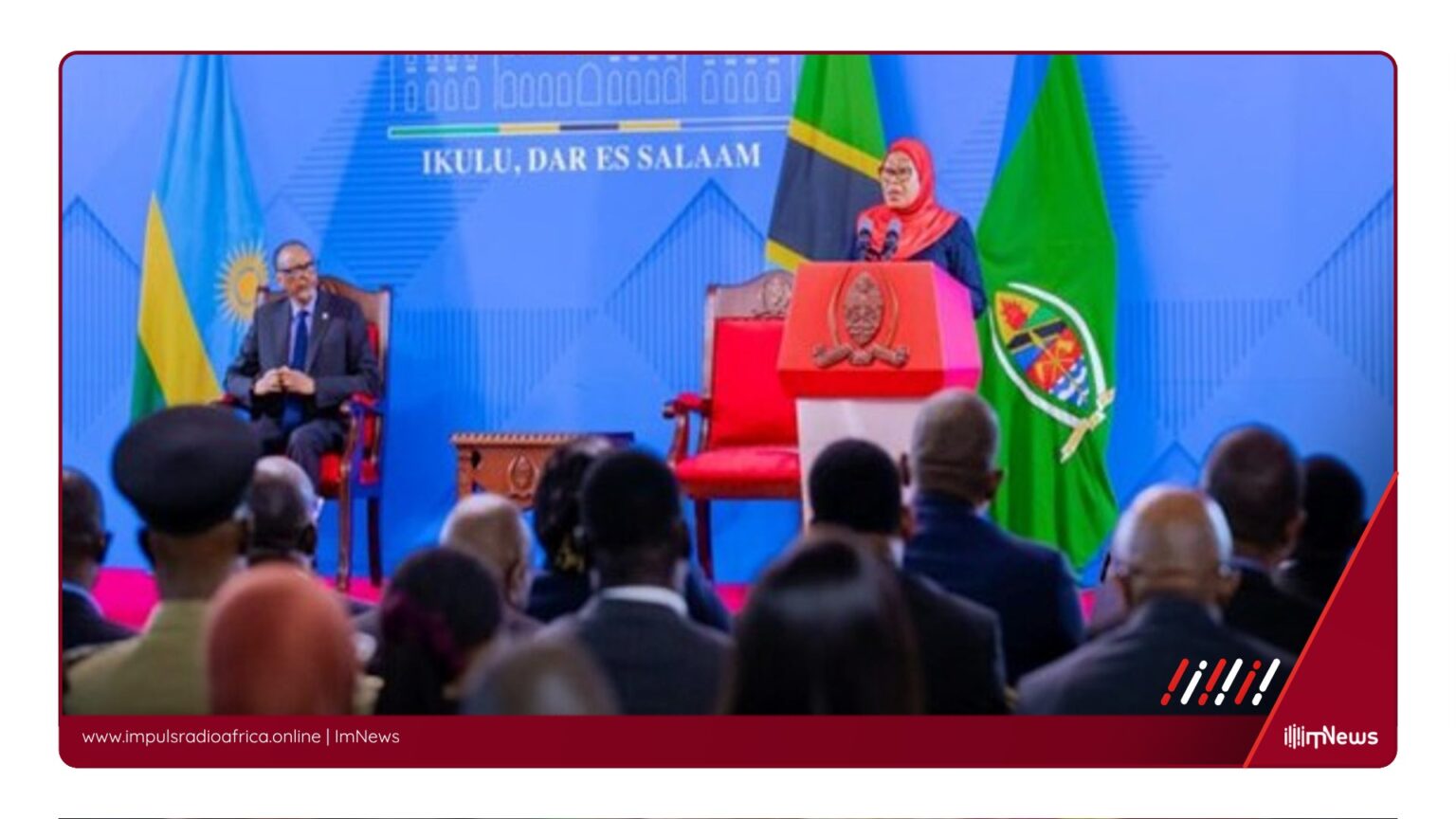
In a high — level meeting held recently, President Samia Suluhu Hassan of Tanzania and Rwandan President Paul Kagame emphasized the commitment to strengthening economic ties and fast-tracking cross-border infrastructure. This strategic move aims to transform the promise of regional integration into a tangible reality, enhancing economic networks that could reshape the economic landscape of East Africa.
The talks, which addressed trade bottlenecks, highlighted the potential of the Central Corridor, connecting Dar es Salaam to Kigali, and the ongoing construction of Tanzania’s standard-gauge railway. This infrastructure is expected to revolutionize inland cargo movement, benefiting not only Rwanda but also Burundi and parts of the Democratic Republic of Congo.
The current bilateral trade between Tanzania and Rwanda, estimated at around $200–300 million annually, is believed to be an underestimate. With improved trade corridors, this figure is expected to grow significantly.
The development of these corridors is seen as a critical step towards regional integration and economic growth.
The Standard Gauge Railway (SGR) line, currently under construction, is poised to transform East African trade, with the Tabora-Kigoma line set to slash transit costs and redefine trade routes connecting the Indian Ocean to the Great Lakes. This infrastructure project is not just a feat of engineering but also a physical manifestation of a deeper struggle to harmonize the East African market.
In addition to the SGR, Tanzania and Rwanda have committed to enhancing cooperation in air connectivity, railway development, and the promotion of Kiswahili. These moves are part of a broader effort to consolidate the region’s economic and security agenda, with the “power triangle “of Kigali, Dar es Salaam, and Nairobi at its core.
The Isaka — Kigali SGR, a crucial component of this strategy, is being built to start at the inland container depot at Isaka in Tanzania and extend to Kigali, Rwanda. Despite the financing gap between the vision and the track, the commitment to regional integration remains strong.
The visit of President Kagame to Tanzania underscores the diplomatic momentum within the East African Community (EAC) as it focuses on deepening regional integration.
The strategic realignment in East Africa promises to reshape the economic contours of the entire continent, with Tanzania and Rwanda at the forefront of this transformation.
In conclusion, the development of trade corridors between Tanzania and Rwanda represents a significant step towards regional economic integration. While challenges remain, the commitment to regional integration and the strategic projects being pursued are indicative of a new chapter in East African economic development.
*Additional reporting by ImNews | Sources consulted: 5*
—
This original article was produced by the ImNews editorial team
Source: Panafricanvisions
Source: Pan African Visions