Navigating Information’s New Frontlines: The CDAC Network’s Insight into Lebanon, Sudan, and Myanmar’s Humanitarian Challenges. Khartoum, Sudan — April 22, 2026 In a groundbreaking report, the CDAC Network has delved into the complex interplay between information and humanitarian aid, drawing on experiences from Lebanon, Sudan, and Myanmar to underscore the critical role of information integrity in modern crises.
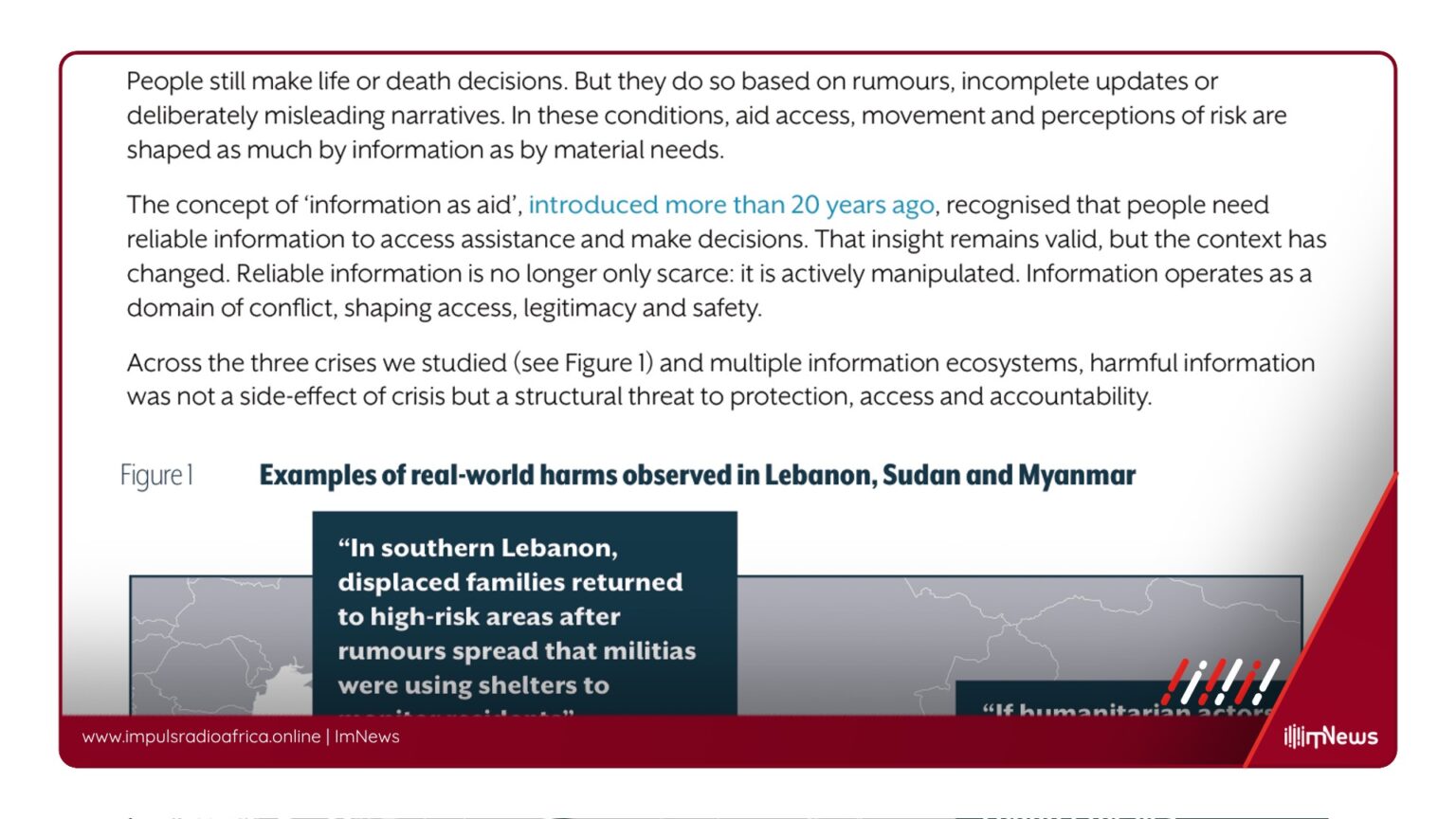
The report, titled “Information as Aid 2. 0: Lessons from Lebanon, Sudan, and Myanmar, “reveals a concerning trend: as information has become weaponized, its manipulation has emerged as a structural threat to protection, access, and accountability in conflict zones. Central to the CDAC Network’s analysis is the recognition that reliable information is no longer merely scarce but actively manipulated, transforming it into a domain of conflict.
This shift has profound implications for aid access, safety, and legitimacy in conflict zones. One of the report’s key findings is the importance of trust in information sources. People act on information from sources they trust, not necessarily those that are most accurate or official.
The absence of trusted channels can render even accurate information ineffective. Moreover, the report highlights the dangers of information silence. When institutions delay or avoid communication, the vacuum is often filled with rumours and disinformation, exacerbating the harm in fast-moving crises.
The CDAC Network’s research also underscores the pivotal role of local actors in reducing harm. When communities and local networks have the capacity to interpret and verify information, harmful narratives lose traction. These actors, already functioning as frontline responders in the information environment, are crucial in shaping a more resilient information ecosystem.
Global measures designed for stable contexts are inadequate in crisis settings, where language gaps and weak moderation increase exposure to harmful information.
The CDAC Network calls for a transformative approach to crisis response, treating information integrity as fundamental to all humanitarian objectives. To foster this transformation, the CDAC Network recommends four critical shifts: 1. Treating information integrity as vital and interdependent with other goals of humanitarian assistance.
2. Funding and connecting local communication and verification networks. 3.
Bridging humanitarian and media ecosystems through mutual understanding. 4. Pushing for inclusive global information integrity governance.
The report envisions a future where trusted information reaches people early, before uncertainty and misinformation take hold. It calls for proactive and transparent communication from governments and humanitarian organizations, with a commitment to information integrity embedded across all humanitarian action.
As the humanitarian landscape continues to evolve, the CDAC Network’s report serves as a clarion call for stakeholders to prioritize the localization and integrity of information networks in crisis settings.
The future of humanitarian aid depends on it.
*Additional reporting by ImNews | Sources consulted: 5*
—
By This original article was produced by the ImNews editorial team
Source: reliefweb
Source: CDAC Network