


The security situation in the Democratic Republic of the Congo (DRC) remains unstable, marked by ongoing conflicts between armed groups and state forces, as well as a multitude of related risks that severely affect civilians.
In the provinces of Nord — Kivu, Sud-Kivu, and Ituri, insecurity is structural, with targeted reprisals, extortions, intimidations, movement restrictions, economic pressures, and land conflicts continuing to degrade the protection environment. Even areas without direct confrontations are affected by armed movements and intercommunal tensions, as seen in Tanganyika province.
The escalation of armed violence has led to significant humanitarian consequences. New waves of displacement, often sudden and massive, have increased the vulnerability of households facing urgent protection and assistance needs. At the same time, access to essential social services has decreased due to the closure or dysfunction of health, educational, or administrative structures, as well as the reduction in the operational coverage of some humanitarian partners, directly affected by security constraints.
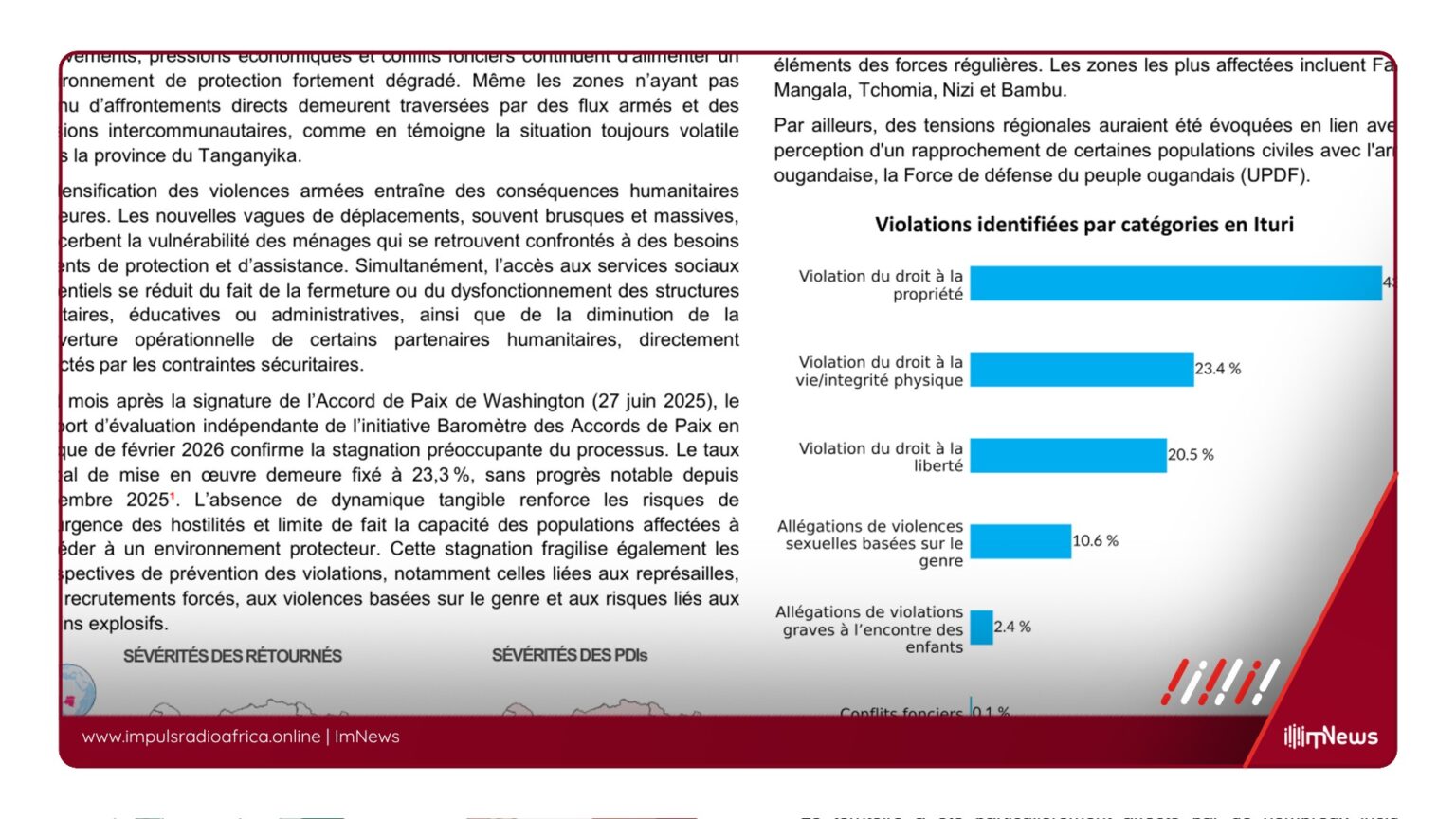
Eight months after the signing of the Washington Peace Agreement (27 June 2025), an independent evaluation report of the Barometer of Peace Agreements in Africa initiative in February 2026 confirms the concerning stagnation of the peace process.
The overall implementation rate remains at 23. 3%, with no significant progress since November 2025.
The lack of tangible momentum reinforces the risks of the resumption of hostilities and limits the affected populations’ability to access a protective environment. This stagnation also weakens the prospects for preventing violations, including reprisals, forced recruitment, gender-based violence, and risks related to explosive devices.


