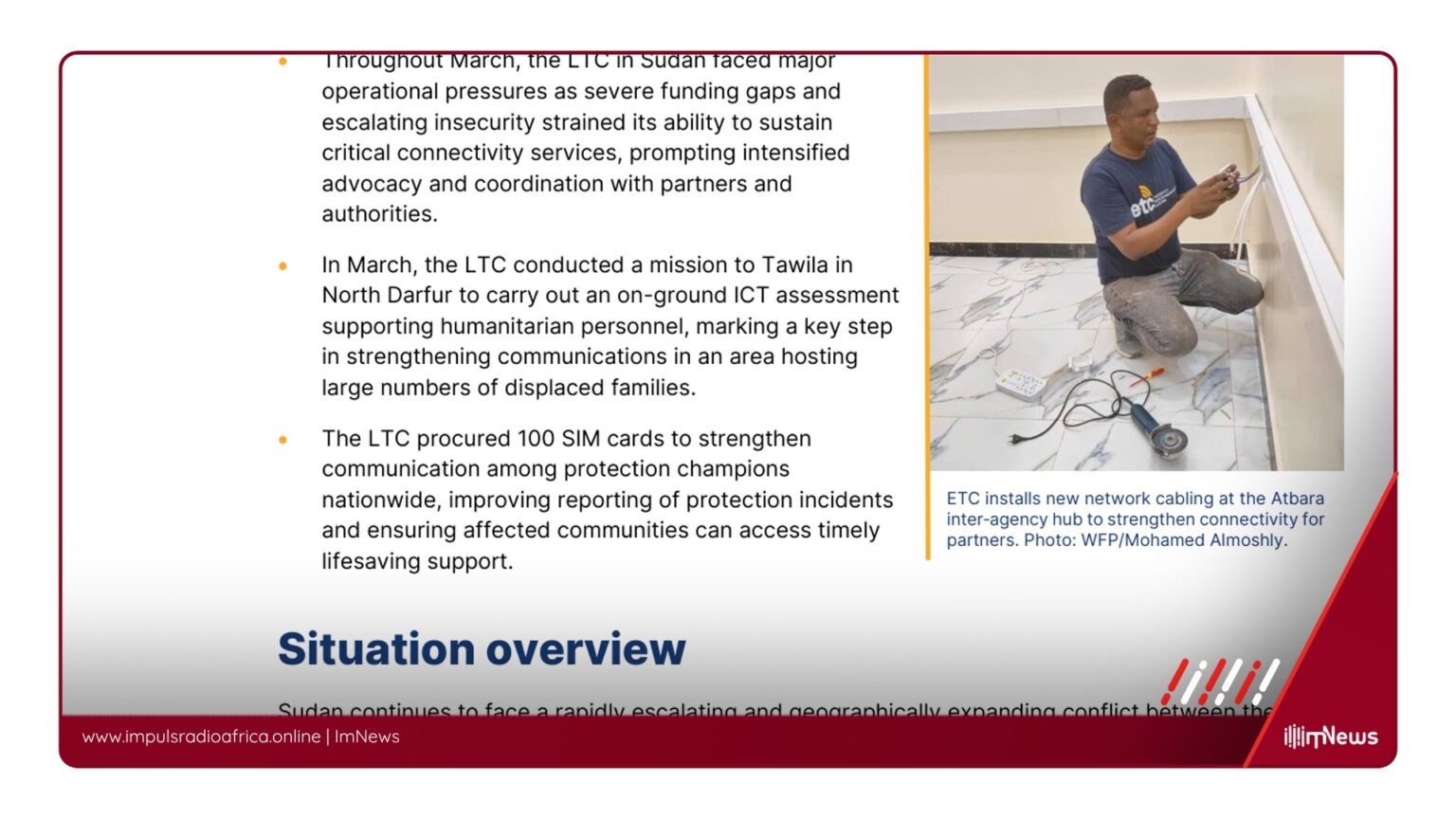
Khartoum, Sudan — The Logistics and Telecommunications Cluster (LTC), led by the World Food Programme (WFP), has been activated since May 2023 to support the humanitarian response to the conflict in Sudan, which began on April 15, 2023. Throughout March, the LTC faced significant challenges, including severe funding gaps and escalating insecurity that affected its ability to provide critical connectivity services. The situation has prompted intensified advocacy and coordination with partners and authorities.
In an effort to strengthen communications in areas hosting displaced families, the LTC conducted a mission to Tawila in North Darfur, where it carried out an on — ground ICT assessment to support humanitarian personnel. Additionally, the LTC procured 100 SIM cards to enhance communication among protection champions nationwide, improving the reporting of protection incidents and ensuring affected communities have access to timely lifesaving support.
Sudan has been addressing a rapidly escalating conflict between the Sudanese Armed Forces (SAF) and the Rapid Support Forces (RSF) since April 2023. The conflict has intensified in March, especially in Darfur, Kordofan, and Blue Nile, with the use of drones, airstrikes, and long-range weaponry leading to high casualties and extensive damage to critical infrastructure. Civilians are at the center of the crisis, facing acute protection risks in the worst-affected states. Humanitarian access is severely constrained by persistent insecurity, active fighting along key supply routes, and administrative impediments.
According to the United Nations Office for the Coordination of Humanitarian Affairs (UNOCHA), clashes along major commercial and humanitarian corridors continued to disrupt aid delivery and movement throughout March. The 2026 Humanitarian Needs and Response Plan (HNRP) is only around 15 percent funded, significantly limiting the ability to scale up assistance amidst unprecedented needs. Critical sectors, including food security, nutrition, health, water, sanitation and hygiene (WASH), and protection, remain gravely underfunded. Without improvements in the security environment and a substantial increase in funding, humanitarian needs are expected to rise further.
UN agencies continue to call for an urgent de — escalation of violence, protection of civilians, adherence to international humanitarian law, and unhindered humanitarian access.
Source: reliefweb