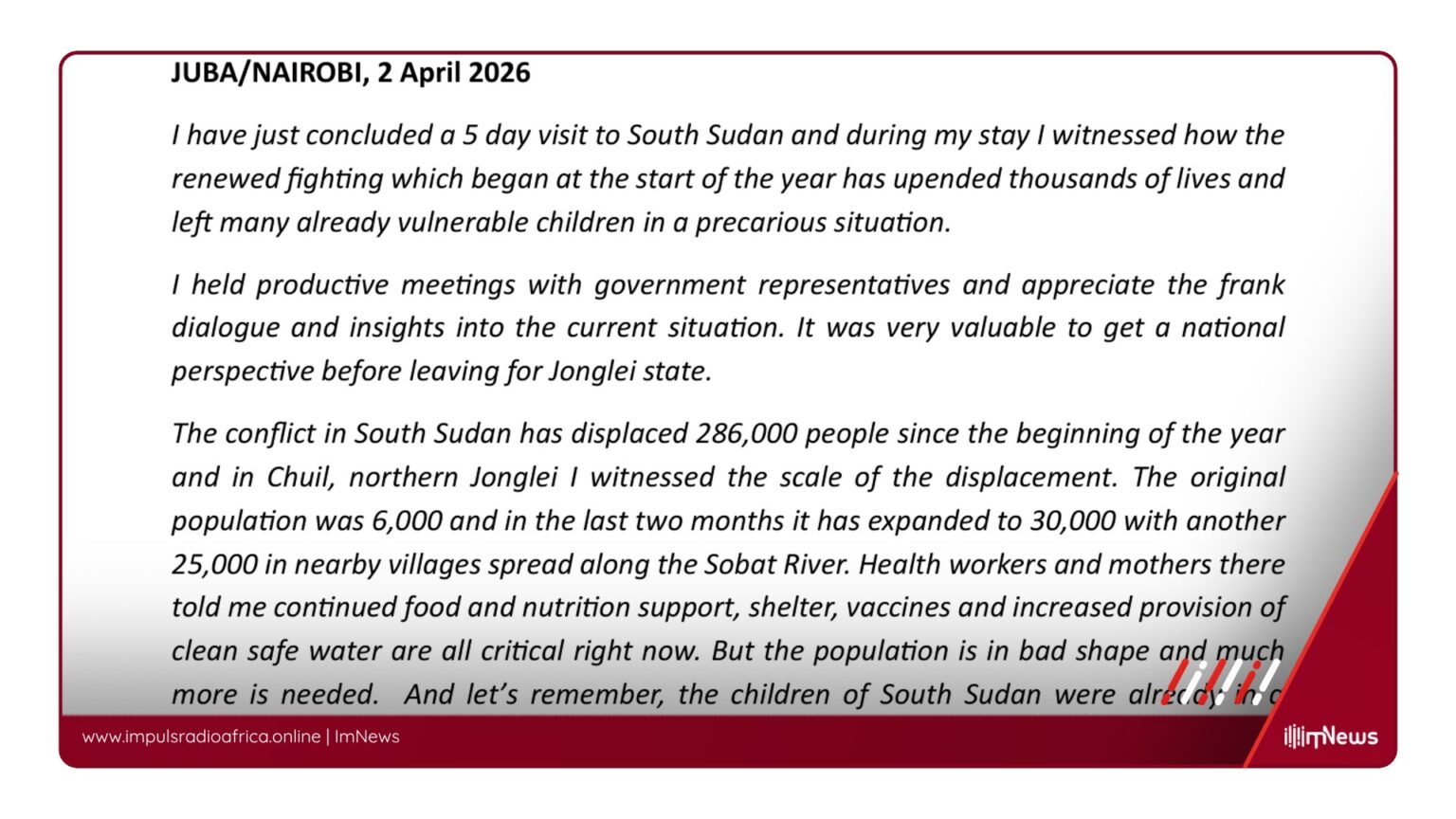
UNICEF Deputy Executive Director Ted Chaiban recently concluded a five — day visit to South Sudan, where he witnessed the devastating impact of the renewed fighting that began at the start of the year. The conflict has upended thousands of lives, leaving many vulnerable children in a precarious situation. During his stay, Chaiban held productive meetings with government representatives and gained valuable insights into the current situation.
Since the beginning of the year, the conflict in South Sudan has displaced 286,000 people. In Chuil, northern Jonglei, Chaiban witnessed the scale of displacement firsthand. The original population of 6,000 has expanded to 30,000, with another 25,000 in nearby villages along the Sobat River.
Health workers and mothers in the area emphasized the critical need for continued food and nutrition support, shelter, vaccines, and increased provision of clean, safe water. However, the population is in poor health, and much more is needed.
The children of South Sudan were already in a vulnerable situation before the conflict started, with over two million at risk of acute malnutrition and 2.8 million outside the safety of school. The health workers also expressed concerns about displaced communities in Northern Jonglei who are unable to reach safety. UNICEF is appreciative of efforts to allow access to many parts of the state, but more is needed to ensure safe, unhindered access to all those in need, regardless of their origin.
Chaiban visited Yuai town in Uror county, where he was shocked by the level of destruction at the primary health care center. The reception and waiting rooms were destroyed and burned, the cold storage system for vaccines was broken, and the water system was vandalized. UNICEF has received reports of 28 health facilities damaged or destroyed across the state this year. Years of investment in health, water, and other public infrastructure cannot be recovered or quickly restored, and civilians and this critical infrastructure need to be protected by all parties.
Several women Chaiban met had lost children during their treacherous journey to find safety. UNICEF has registered 540 unaccompanied children, separated from their parents while fleeing. Some spoke of children abducted by armed youth, a terrifying experience for the mothers. UNICEF and partners are working to trace children and reunite them with their families, and funding and an expansion of protection services for tracing and critical case management are crucial for this effort.
UNICEF is responding to the crisis in Jonglei, delivering 200 metric tonnes of supplies to date and working with staff and partners to scale up services. The organization is expanding support in the areas of health and nutrition supplies, malaria bednets, water, sanitation and hygiene activities, non-food items, and dignity kits. The rainy season is approaching, and UNICEF is calling for urgent action to respond now and pre-position supplies and personnel before roads become impassable.
UNICEF and its UN partners are calling for all parties to end the violence and return to peaceful dialogue. The current crisis risks reversing the small and hard-won gains in improving the life chances of South Sudan’s children. A sustained investment in social services led by the government and supported by external development partners is essential. The potential for a bright future in South Sudan remains, but peace, dialogue, development, and education are the best prospects for the nation’s future.