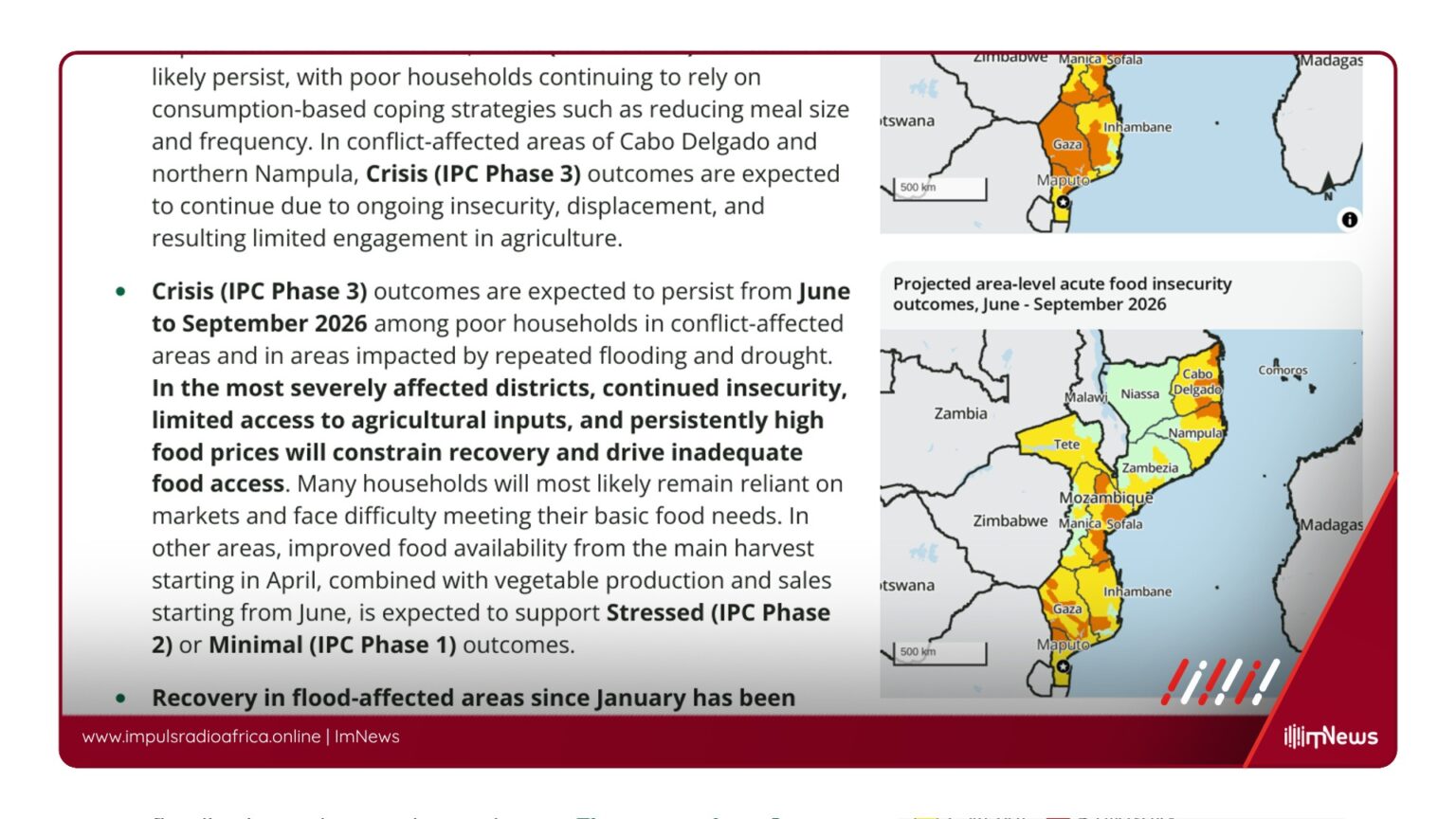
In southern and central Mozambique, areas affected by floods and droughts are expected to experience Crisis (IPC Phase 3) outcomes between March and May 2026, according to the report. This is due to reduced household food stocks, limited income-earning opportunities, and high food prices. Despite an anticipated modest improvement in food access with the April-May harvest, Crisis outcomes are expected to persist, with poor households continuing to rely on coping strategies such as reducing meal sizes and frequencies. Conflict-affected areas of Cabo Delgado and northern Nampula are also facing continued Crisis outcomes due to ongoing insecurity and displacement, limiting agricultural engagement.
From June to September 2026, Crisis outcomes are anticipated to persist among poor households in conflict-affected areas and in flood- and drought-impacted regions. In severely affected districts, continued insecurity, limited access to agricultural inputs, and high food prices will further hinder recovery and constrain food access. Many households are likely to remain dependent on markets, struggling to meet basic food needs.
The recovery in flood — affected areas since January has been slower than anticipated. Following severe flooding in January 2026, a 40-day dry spell with intense heat was followed by heavy rains in March, triggering localized flooding. This sequence of weather shocks caused extensive crop and livestock losses across much of the south and parts of the central regions. With limited food stocks and poor prospects for the main harvest, affected households are increasingly reliant on markets.
Income — earning opportunities remain constrained, with low crop sales and alternative activities like charcoal production generating limited returns due to high competition and reduced production. Weak purchasing power, combined with above-average staple food prices, continues to restrict food access. Limited availability of seeds and degraded soil conditions are also hindering replanting efforts.
The 2025/26 agricultural season is expected to see an average harvest compared to the five-year average, but subnational quantities will vary. Crop production is likely to be well below average in the south, mixed in the center, and above average in the north. Widespread crop losses due to successive shocks during the rainy season, particularly in the southern region, have been significant.
Staple food prices in the south remain above average, despite recent declines, and coupled with below — average household incomes, this constrains market access for affected households. Maize prices in the southern region declined by about 13 percent from January to February, but were still roughly 25 percent above the five-year average. Rice prices in the southern part of the country remained approximately 40 percent above the five-year average.
The escalation of conflict in the Middle East is expected to exert modest, delayed pressure on food security in Mozambique between March and September 2026. Current conditions are supported by stable domestic fuel prices and exchange rates, which are slowing the immediate transmission of global shocks to the consumer. However, if global fuel prices remain elevated, higher transport and distribution costs are expected to gradually increase staple food prices.
The Ministry of Agriculture, Environment and Fisheries (MAAP) reported that by February 2026, about 449,000 hectares and over 530,000 animals were affected, impacting around 335,000 smallholder farmers. Maize, rice, beans, and vegetables were the most affected crops, with Gaza (87 percent), Maputo (21 percent), and Sofala (13 percent) provinces recording the highest shares of affected planted area.
Food Security Cluster (FSC) partners reached about 156,000 people with food assistance by February 2026, primarily in Cabo Delgado and Nampula. By the end of March 2026, flooding response efforts supported around 163,000 people, mostly sheltering in accommodation centers with one-month food rations. In the coming weeks, at least 137,000 people are expected to receive agricultural assistance, primarily vegetable seeds for the second season. However, the World Food Programme (WFP) requires 98 million USD to sustain operations over the next six months; without additional funding, the number of beneficiaries in Cabo Delgado could drop from 420,000 to 265,000 by March 2026.
Source: reliefweb