Lagos, Nigeria — April 21, 2026 The humanitarian landscape in Cameroon is under immense pressure, as the nation grapples with the repercussions of concurrent crises.
The Far North region, beleaguered by the Lake Chad Basin conflict, faces additional challenges from cross — border attacks and climate shocks.
The North — West and South-West regions are witnessing recurrent displacement due to violence between non-state armed groups (NSAGs) and state security forces (SSFs). Simultaneously, the East, Adamawa, and North regions are hosting hundreds of thousands of refugees from the Central African Republic, placing a heavy burden on social services.
The situation is compounded by high levels of food insecurity and acute malnutrition among children under five, which persist across several regions. Access constraints, poor infrastructure, and administrative hurdles further impede the delivery of humanitarian aid, leaving some communities without regular assistance.
As of March 2026, the UN Office for the Coordination of Humanitarian Affairs reports that 2. 9 million people in Cameroon require humanitarian assistance. Humanitarian partners are aiming to assist 1.
9 million of the most vulnerable individuals, with a funding requirement of $319 million.
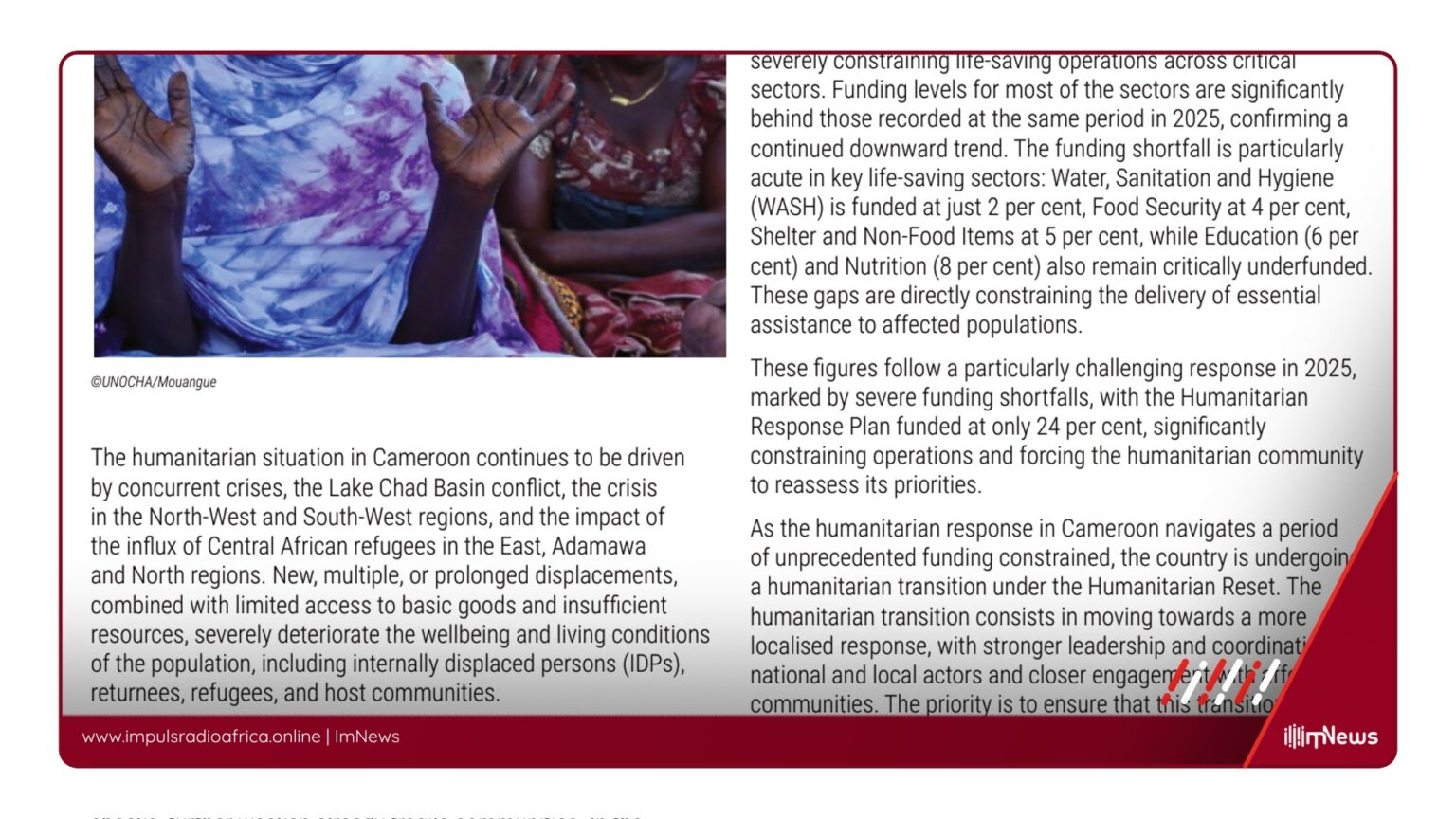
However, as of the end of March, only 20 per cent of the Humanitarian Response Plan has been funded, leaving a $253 million gap. This shortfall is particularly pronounced in critical sectors such as Water, Sanitation and Hygiene (WASH), Food Security, Shelter, and Nutrition.
The humanitarian response in Cameroon is also navigating a period of unprecedented funding constraints, with the 2025 Humanitarian Response Plan funded at only 24 per cent. This has forced reassessment of priorities and a shift towards a more localized response, emphasizing stronger leadership and coordination by national and local actors, and closer engagement with affected communities.
The transition, known as the Humanitarian Reset, aims to enhance effectiveness and accountability while maintaining principled coordination and technical support.
However, the success of this transition hinges on sustained engagement and increased support from donors and partners. Without additional resources, the ability of humanitarian actors to respond effectively to the multifaceted crises will be severely compromised, leaving hundreds of thousands of people at risk and further eroding community resilience.
*Additional reporting by ImNews | Sources consulted: 4*
—
By This original article was produced by the ImNews editorial team
Source: reliefweb
Source: UN Office for the Coordination of Humanitarian Affairs